By Annie Howell and Jennifer Lachance
May 18, 2026
Listen on:


Trust is a Core Leadership Skill
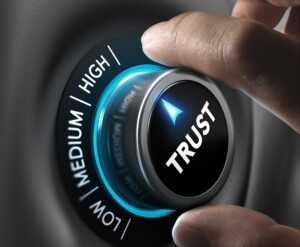
Why leaders need to build trust, and how to do it
When teams have a strong foundation of trust, the work just feels easier. Even when there’s a lot going on — changing technologies, pressing business imperatives, strategic uncertainty — team members who feel a high degree of trust with each other can work through their challenges more successfully. But trust is a nebulous thing. What specifically can a leader do to increase trust when it seems to be lacking?
In this episode of the Knowing Kenning podcast, Partners Annie Howell and Jennifer Lachance share a powerful framework: the trust equation. They walk through four elements that build trust, and they bring them to life with illuminating case studies drawn from their own coaching work. In doing so, they describe small shifts that any leader can make to show up in a way that enhances stability, clarifies priorities, makes people feel seen and understood, and brings multiple perspectives into the room. If you suspect trust might be slipping on your team, they offer a call to action to make changes in small but important ways.
Listen
Authors:

Related Articles:

Related News & Ideas

Related News & Ideas
Related News & Ideas
Transcript:
Jen: I’m Jen Lachance, partner at Kenning Associates, and I’m here with my colleague, thought partner, and good friend Annie Howell.
Annie: Hi everyone.
Jen: Through our Knowing Kenning podcast, we explore the complex dimensions of leadership in lots of different ways. And today we’re talking about something that sounds simple but is actually pretty foundational, and that’s the idea of trust.
So we are hearing across the board that work right now is a lot. For some people it’s exciting, it’s fast moving, it’s full of possibility. There’s a lot of interesting things on the horizon. And for others it can feel a little uncertain, even possibly destabilizing or anxiety producing. And so the question becomes, what actually holds things together?
Annie: For us, one key element is trust. And what we’re seeing more and more is that trust isn’t just a “nice to have”. It’s becoming a core leadership skill. And while everyone contributes to trust, it’s really the leader’s job to notice when it starts to slip and to actively rebuild it. So let me give you an example because we feel like examples really help with this.
I had a coaching client, I’m going to call her Cora. She’s a director of talent and strategy for a large tech organization. She’s incredibly experienced. She blows me away. She has 20 plus years tackling tough questions over time with really good success.
Until recently, Cora was known for collaborating with her team. She had almost a peer-like quality to her way of leading. They aligned the vision of the organization and the hiring process, which is what you do in talent and strategy, but they also developed new ways to match compensation with impact. They challenged the organization overall when there’s a lack of diversity at the leadership level, and among her teammates, she was really revered as an active listener who tried to step outside of the predictable framework when needed. In addition to that, Cory was a fierce advocate for team members when they themselves needed promotions.
So now, like everybody else in today’s world, in 2026, Cora is being asked to integrate AI into that process. So her already complex work just got way more complex. Of course, Cora is learning new systems. She’s experimenting with tools that she’s not sure where they’re even going to work. She’s trying to keep up with the day-to-day deliverables that are on her plate. And she’s thinking about how all this might reshape her team because Cora a curious and lean-in kind of person. She loves this challenge, and she’s what we would call heads down. Because of how all-encompassing this work is, Jen, she’s been canceling team meetings last minute. She’s not following up with her direct reports on their deliverables. And honestly, in her mind, she felt like they could carry on the work without her while she led this new endeavor. But if you looked at it objectively, she was just absent from the team.
Jen: That sounds familiar across a lot of my clients when these kinds of new initiatives come up.
Annie: I know very, very, and who knows, when you say a lot of your clients, it may not even be the current AI trend that’s taking over leaders’ streams. Like it could be something else, because we’ve seen this historically that this kind of a thing happens. But okay, so the day before one of our coaching meetings, Cora had a conversation with one of her direct reports named Andrea.
Andrea is 15 years junior. She’s younger than Cora, and she sees Cora as a mentor. I know this because Cora came to one of our coaching meetings, really, really proud because Andrea had told her that she felt like she hit the jackpot when she joined Cora’s team. I know it’s very sweet. And Andrea usually comes in engaged, she’s curious, she’s energized. She really feels like she’s in the best place usually for her work.
So in this meeting, this is a typical one-on-one meeting – they meet every three weeks or so – something feels like a little bit off. Cora comes into this meeting, she’s unprepared, she doesn’t have an agenda because she’s just too busy to be able to form one. And oddly, Andrea, who’s usually sort of a backup in terms of preparation, also has not brought anything to the meeting. And so they do what is like a little bit unusual for them. They kind of superficially go through weather small talk, and then there’s this long awkward pause. And so finally Cora says to Andrea, “you know, what should we talk about today?” And Andrea quietly looks off to the side in the Zoom room, and says, “I really don’t know.”
Jen: Oof.
Annie: Yeah, right. I’m glad that you felt that too, Jen.
Jen: Sorry. I did, I actually felt that, I was like, oh, that feels like an awkward moment.
Annie: Yeah. Because it wasn’t just unfocused, but it was a moment of disconnection between them. And the moment was really small, it was just a comment that was made, but it was kind of a big eye-opening signal to Cora. And so Cora like woke up. She tuned in at that moment, and she finally said in a more focused way, took a deep breath and said, “tell me more about what’s going on for you, Andrea.” And Andrea felt a little bit of an opening to lean in and talked with honesty and transparency about how the team feels right now that they feel untethered. They’re worried about AI replacing their roles, which we know is happening across the board right now, and they’ve seen other departments in the organization shrink.
They’re not sure that their work matters because they don’t really have anybody to touch base with, because Cora is off and running. And one person on their team who’s usually fairly active, actually skipped a training meeting recently because he didn’t think that anyone would even notice. And quite honestly, those who did notice weren’t even sure that they wanted to call him out on it because they kind of agreed with them. So they were starting to feel invisible.
And they missed the way that Cora used to lead the team in a connected community-like way where they knew what each other was doing with their work streams. And they even knew about each other’s home lives, their wins, their challenges, whether a parent was sick, for example. And they used to have a regular cadence to their meetings and brought in creative solutions to the work because they all had a finger on the pulse of what was needed. But now they were starting to feel vulnerable and disconnected.
So in that moment when Andrea was describing the current context, Cora realized that while she was focused on this other work and incorporating AI tools into the work stream, the trust on her team had started to just erode.
Jen: Another oof.
Annie: Yeah. Jen. You know, you were born and raised in New Hampshire, so I’m going to use this kind of funny analogy just because I’m a Vermonter and I’m in that space right now. Early spring in Vermont is oftentimes, shall we say a little bit, neglected. You come out of winter where everything’s covered in snow, and the snow’s starting to melt on the paths and everything looks like a little bit off and cluttered, and I’m sure that you remember that from your days, not in California, but living in New Hampshire.
Jen: Mm-hmm. I remember that well.
Annie: Nothing’s broken, but it’s not working the way that it should be working. You have all these winter projects that you thought that you were going to get to in the fall, like your artwork hanging it on the walls, but it’s still sitting on the floor. There’s a goodwill bag that’s full of worn clothes that you cold from your kids’ closets, but you still haven’t donated it. The outside garden beds, they’re full of leaves, just like everything’s just like a little bit off.
And that’s what Cora’s team felt like. You know, just everything was a little bit off. Cora took this moment to step back, and she decided that she didn’t need to overhaul everything, right? But she needed to tend to it and to rebuild the foundation, so to speak. Because without this interconnectedness of trust between them, none of the other work really sings. It just doesn’t. That’s what it felt like. That was the context for Cora and Andrea and their team.
And Jen, we talk about trust all the time in leadership development, but it can feel really abstract to people. So maybe they’re resonating with this story, but the question is, what do you do about it? And I know that we love a tool that makes it really, really concrete.
Jen: We do, we do. We love this tool called the Trust Equation from Meister and Green, from a group called the Trusted Advisors and, uh, huge fans here.
Annie: I know. So if you could see us, we’re basically waving our hands in appreciation for their tool because it’s one of our favorites. We go to it all the time.
Jen: And Annie, can I just come back to the New England and spring analogy because a lot of times we can look around in that case and say, I know how to tend to things, but when we talk about trust with people, sometimes they say, I know I need to tend to it, but I don’t know exactly what to do. And what I love about this equation is that it breaks it down.
Annie: Yeah, so do you mind, I think you’re just on a roll right now. If you can share how it works for the listeners, that would be really helpful.
Jen: I do love to talk about this. It’s true. Okay, so the way they laid it out is like a math equation: trust equals credibility, plus reliability, plus intimacy. And that’s the numerator. And then over self-orientation in the denominator. So if you have a paper and pen, you could actually write it out, like credibility plus reliability plus intimacy. Draw the line underneath. And then the bottom line or the denominator is self-orientation. I think it’s helpful to talk through each of these, but if folks remember middle school math, the key with that denominator is that if the denominator increases the overall score goes down. So if self-orientation goes up, trust goes down, and that’s one of the key things that we think about.
Annie: So, can you continue this thread that you’re on right now, Jen, and just break it down a little bit for people like each of those elements.
Jen: Okay, let’s, maybe we take turns. So I’ll start with credibility. The first term in that numerator at its core, credibility, comes down to do people believe that you know what you’re doing? That can come from expertise or experience or just how clearly you communicate both what you do know and what you don’t know. And actually that’s where we see people get really tripped up, especially earlier in their careers. They think they have to project certainty all the time.
Annie: Because it actually backfires. If people feel like imposters or they’re perceived as imposters, you know, it just doesn’t really work.
Jen: Exactly. So credibility isn’t about pretending, it’s about being accurate with what you know and being authentic about what you do and don’t know in that way that builds trust.
Annie: So for Cora, she’s highly credible with her 20 years of experience in promotion and talent strategy. But in AI, she doesn’t really know it. She’s just learning like the rest of us are. And if she were to overstate what she knows, she actually loses trust. If instead she says, here’s what I know, here’s what we’re testing, and here’s what we don’t know yet, that ownership over that builds credibility because it really actually is the truth in this complex world, right? Because how can you know what it will look like if it’s not been built yet? So you don’t know. You do need to convey confidence that you have the leadership skills to lead this adaptive work, but not that you’re an expert in what it’s going to look like when it’s complete, because you actually don’t know. So it’s kind of a grounded confidence.
Jen: Yeah, it’s that way of being clear about how you might lead the process, but not pretending you have an expertise that you don’t have.
Annie: You have the confidence in the process and not in the outcome because you don’t know the outcome yet.
Jen: You want to take reliability?
Annie: So reliability is the next one on the line. And this one I find is really straightforward. It’s sometimes, we call it, table stakes for professionalism. The basic of it is do you do what you say that you’re going to do. When you say that you’re going to do it with the quality that’s agreed to. So early in your career, this is, it’s everything. And I say this to my kids all the time. I have a 21-year-old and an 18-year-old, and they’re just, entering the professional scene. And, for them, just being reliable, I tell them, is going to set you apart immediately and give your directors and your teammates a big sigh of relief that they can count on you, that they can trust you.
So I give them tips, like respond in a timely way. It seems kind of obvious, but it’s not that obvious for a lot of people, even people who’ve been in the professional world for a long time. Respond in a timely way. Don’t say yes if you don’t understand the ask. You’re making a commitment whether you knew it or not. You have to be clear about what you’re being asked to do and analyze honestly whether or not you can actually do it. That’s what being reliable is. It’s fairly straightforward.
Jen: Yeah. And that alone I find builds a ton of trust, especially earlier in your career, but you’re laying that foundation of how you can be responsive and thoughtful about what you commit to.
Annie: So reliability actually evolves as your role gets more complex. We’re talking more about like the core level of complexity. So for Cora, it’s less about checking off the tasks and doing them on a timely way, but it’s more about creating consistency for others. When work gets really complex, reliability for somebody like Cora looks like, are you communicating to your direct reports, peers and leaders regularly? Are these constituents clear on where things stand? Do you keep your team connected to the direction even when that direction is shifting? Those are much more reliable skills in this complex world.
Jen: Yeah. Annie, as you say that to me, I’m hearing this shift especially further along in your career, that it’s less about tasks and more about creating stability.
Annie: Yeah. it’s also about being able to know more clearly what you cannot do because it’s not in line with your vision or your priorities, right? So in a reliable space, you don’t say yes, all the time. You actually start saying no more often and with ease. You say no to your direct reports, you say no to your peers, and you also say no to the higher, more senior constituents because you own your work differently and you know what needs to get done.
So I was working with another client, call him Tristan. When he showed up to our meeting, he honestly looked totally haggard. Jen, you know, like the bags under your eyes, a bit sloppier clothes than he typically shows up in. And he said, this team just lost another member of their group. This company’s on hiring freeze, so he had to pick up more and more work. And he said that there’s just no way that he can say no right now. And he just has to keep on giving. It feels like he’s drawing water from a stone, he just has no more capacity to be able to do it, but he he feels like he has to keep on saying yes.
So I admit this may be true for a short while, but at some point Tristan is going to need to set his priorities again and make sure that his long-term plan is well laid out. And this may feel like yes, it’s like an honor for a lot of people. You know this because a lot of people sometimes get praise for saying yes. But you have to, he has to, learn how to say no. And that actually is being reliable at a senior level.
Jen: Right, and that can be so uncomfortable for folks, but at that level, that’s what good reliability looks like. So let’s go into intimacy, which we sometimes call relatability. This is that third term in the numerator. And this is really like, do people feel known by you and do they feel seen? Do you actually understand them as people, not just what they do, but how they experience things?
Annie: Right, and it’s where leadership gets human.
Jen: Exactly. Because when people feel seen and understood, trust tends to go up pretty fast. This is one of those things that can sometimes feel intangible to folks. It doesn’t mean oversharing or crossing boundaries at all, but it means paying attention to what’s going on with other people. And it requires things like listening really well, remembering what matters to someone, understanding how they think and work.
Annie: Right, like in Cora’s case, this is what helped her to catch that something was off with Andrea.
Jen: Exactly. That moment with the look to the side from Andrea that would only register with Cora if she really knows Andrea. So those little clues, people give us data and it really only registers if you know them.
Annie: Right, like Cora didn’t misread Andrea as slacking off, or that Andrea was incompetent in any kind of way because she said that she didn’t know, but she knew at a deeper level that “I didn’t know” meant “I’m feeling off track and I don’t like that, and I don’t trust that.”
Jen: Yeah, exactly.
Annie: So to keep things moving on the Trust Equation, let’s talk about the denominator, self-orientation, the part that’s below the line. And because as Jen said, this is the denominator, it really drives the whole thing. The higher your self-orientation, or the higher you’re perceived to have self-orientation, the lower the trust becomes.
Jen: Yeah, exactly. So essentially this is, how much is this about you? And how much can you see beyond your own perspective? Lowering self-orientation doesn’t mean that you just give up what you need, but it does mean kind of letting go of your agenda, so not holding your perspective so tightly that you feel that you need to be in control and are incapable of taking someone else’s perspective.
Annie: So like this can feel like the antithesis for a lot of leaders, but the shift becomes rather than, “what do I need to get done as the leader?”, it’s “what does this situation and these people, the people in this context, need?”. And of course, you need to know your own perspective as a leader because having that vision is part of your work. But you hold your perspective at a distance so that you can see it, be part of a bigger picture, and you know that your perspective is part of this larger system. And the system is not really complete with just yours in it.
So I like to think of it as looking through a kaleidoscope where a leader needs to see the dance of all the little colorful pieces that are in that looking glass, and each of those pieces. It’s essential to the experience of a kaleidoscope, because if you were looking through a little tube and all you saw was one little red speck at the end of the tube, there’s really nothing interesting to look at. But the kaleidoscope becomes a way to see all these pieces and the experience fitting together. So I know that that’s a little bit of a more colorful analogy, but I think that that’s really what it means to see the whole system at play.
Jen: I love that analogy. Because when we look at kaleidoscope, you’re right, what’s really cool is how everything relates to each other. But if you can only see your little square, you’re not going to understand that bigger picture and people will experience you as not being willing to see that.
Annie: Exactly. So for Cora, she needed to lift up her head. It meant lifting up her head to see the big picture, like she needed to breathe in the system again and see her team again as a whole. And bringing people back into the work, not just to make them feel good, because it’s not just about that, but because the work actually needs their perspective.
Jen: Mm-hmm. Right. That’s the power I think, right there, is when it’s less about you. When you’re thinking more broadly, people trust you more. I’m guessing people listening can imagine that situation of that person that really thinks about that system more holistically.
Annie: Yeah. Okay. So we just walked through the Trust Equation. So, Jen, how do you use the Trust Equation in your coaching?
Jen: Okay. I use it a lot with folks, with both individuals and teams that I coach. And I use a pretty simple diagnostic. I’ll have clients rate themselves one to five on each of the areas we just talked about: credibility, reliability, intimacy, and self-orientation. And I should say I have them think about a relationship where they want to build trust, and they think in that space, how am I on each of those elements? And then I ask, if you were to take your team’s perspective or that person’s perspective, how do you think they would rate you? And then we see the gap, right? And that gap is where the work is.
Annie: Yeah, I mean, it’s kind of a, like an easy, but a really good question that you’re asking.
Jen: Yeah, it’s pretty straightforward. and then we pick just one area to focus on. Most people go, I’m going to fix everything. And I reinforce, you don’t have to fix everything. Just move one lever that’s a priority. And so maybe I can be more specific with that.
Annie: Yeah, please keep going.
Jen: Okay, so for instance, let’s say a leader does this little quick assessment and they’re low in credibility. So first we want to rule out the possibility that they don’t know the subject material, right? So we talked about the examples of like, sometimes you do, and you have to be clear about where you know it and where you’re learning still. and if they don’t know the subject material well, we think about what expertise they do bring to their job.
So I always love that show, Ted Lasso, and a shout out to our colleagues Mike and Cathy, who have their podcast called Lasso Lessons, one of my favorites. But if you listen to that or if you just watch the show, you’ll know that Ted was not hired because he was an expert soccer player. He actually knows nothing about soccer, but he did know how to lead a team well. Ted was clear on where his credibility was, and he didn’t pretend to know soccer really well. And so that’s the kind of thing that I want to think through with my clients. If they’re thinking about, I’m low on credibility, what is the expertise they bring to the role and how do they make that strength more present while also being honest about where they don’t have deep subject matter expertise?
Annie: Yeah. Great. I like this, uh, word authenticity again. Okay, so you picked up credibility, which I think is important, and I’m going to tackle the denominator because it can be a little bit more abstract. So if they perceive or if they feel like others are perceiving them as too being high in self-orientation, and I want to help them to be lower in self-orientation, because as we said, lower in self-orientation raises more trust, I often ask them to draw a version of what we call an empathy map. And there are many ways out there to do an empathy map, but in the Trust Equation version that I offer, I ask them to write their impact statement in the middle of the page and we circle it. And Jen, we do this old school, like you were talking about before with pen and paper.
So for Cora, her impact statement was, “I want to create impact by bringing innovative technologies to our work to broaden, not replace, our expert strategies around talent and promotions.” So that’s what her impact statement was. And after adding that impact statement to the page, we literally draw lines radiating from that circle, and I ask her, or whoever my coaching client is, to put diverse names around at the end of each of those lines, like almost like a balloon with a string attached to it, you know, with a person to the end of it. And I ask them to think about what is that person’s perspective on the impact statement? Of course, if they don’t have a clue, they’re making it up, then you should go ask them. Like, that’s, that’s a no brainer. But one of the lines that’s coming off of the impact statement is for them, so that they can see themselves as part of the whole picture. This is like part of the rigor of leadership.
So for Cora, when she added, for instance, Andrea’s name at the end of one of those lines, and Andrea is representing her team, of course, not just Andrea, Cora had a better awareness of what it would take for the team to feel ownership of that impact statement and what it would mean for her to build trust so that they felt like they could be connected. So part of this Cora and I worked through, was what communication would look like on a more regular and transparent schedule? She started to design something called listening meetings where she would ask her teammates just the basic question, you know, what did you notice? And she also started asking a teammate to join her in meetings with other directors so that that the team could be an additional representative to the senior stakeholders asks, so it wasn’t just Cora doing it, but it was another team member as well.
So all of these moves started to integrate the team again and started to build trust within it. And it took a couple of months, but people started to feel like they were sort of rocking and rolling again. Kind of integrated in a nice way, that she could feel trust was happening and she wasn’t going to have a meeting where Andrea was going to show up again and look off to the side and say, “I don’t know what this meeting is about.”
Okay. So just imagine that Cora hadn’t done that. She hadn’t noticed that her team was lagging in trust. She’d stayed head down. She hadn’t had the meeting with Andrea. Her team kept on feeling uncertain, unseen, disconnected. So just to say that that erosion of trust, it does not stay small. It spreads and builds over time, and oftentimes it can be very hard to pull back when it’s significantly broken.
Jen: Right. And then once trust really breaks down, everything gets harder. Communication, alignment, execution, all of it.
Annie: Right. You might have that team member who didn’t show up at the training, actually just leave. And it might create rifts in the team as a whole. it really can get to be too far.
Okay. So how do you help it to not get too far? If you’re listening, if you’re leading a team right now, here’s a few questions to sit with. For instance, where might trust be quietly slipping on your team? Use that Trust Equation to evaluate it. What part of that equation feels weakest right now? You might actually also ask the question, where might you be a little too focused on your own agenda? If you’re going to move the denominator, if you’re going to move the needle on that, you might want to ask that question as well.
Jen: Right, because the good news is trust is buildable, and this equation breaks it down to make it straightforward. And small shifts do matter, so things like a clearer message, a kept commitment, a more present conversation, those things make a big difference.
Annie: I love that, like all those tiny moments make a really, really big difference, as you’re saying. And in the moments of complexity, like the ones that we’re all in right now, trust isn’t just helpful, it’s really what you’re saying, it holds everything together.
Jen: Thank you, Annie. I love that way of pulling that together. Thank you for listening with us, everyone. We would love to hear how you think about the Trust Equation and how you might use it in your work. You can find us on our website, kenning associates.com. Annie and I are both on there and would love to hear from you and understand just how this comes alive in your work.
